| Socket |
AM4 |
| Chipset |
AMD X570 |
| Form Factor |
ATX |
| Voltage Regulator |
14 phase / 12 + 2 (“teamed” setup with 7+1 controller) |
| Video Ports |
✗ |
| USB Ports |
USB 3.2 Gen 2 (10 Gbps): 7x Type-A, 1x Type-C USB 3.2 Gen 1 (5 Gbps): 4x Type-A |
| Network Jacks |
(2) Gigabit Ethernet |
| Audio Jacks |
(5) Analog + SPDIF |
| Legacy Ports/Jacks |
✗ |
| Other Ports/Jack |
Wi-Fi Antenna |
| PCIe x16 |
(3) |
| PCIe x8 |
✗ |
| PCIe x4 |
✗ |
| PCIe x1 |
(1) |
| CrossFire/SLI |
AMD 3-Way CrossfireX, Nvidia 3-Way SLI |
| DIMM slots |
(4) DDR4 |
| M.2 slots |
(2) PCIe 4.0 x4 / SATA + PCIe |
| U.2 Ports |
✗ |
| SATA Ports |
(8) 6Gb/s (RAID 0, 1, 5, 10) |
| USB Headers |
(1) v3.2 Gen2, (1) v3.0, (2) USB 2.0 |
| Fan Headers |
(8) 4-Pin |
| Legacy Interfaces |
✗ |
| Other Interfaces |
FP-Audio, RGB-LED, TPM |
| Diagnostics Panel |
Q-Code LED display |
| Internal Button/Switch |
Power, Reset, Slow Mode, Reset CMOS, Safe boot, Retry |
| SATA Controllers |
✗ |
| Ethernet Controllers |
1G - Intel I211-AT 2.5G - Realtek RTL8125-CG 2.5G |
| Wi-Fi / Bluetooth |
Intel Wi-fi 6 AX200 (2.4 Gbps, 2x2, MU-MIMO) |
| USB Controllers |
✗ |
| HD Audio Codec |
SupremeFX S1220 |
| DDL/DTS Connect |
✗ / Yes |
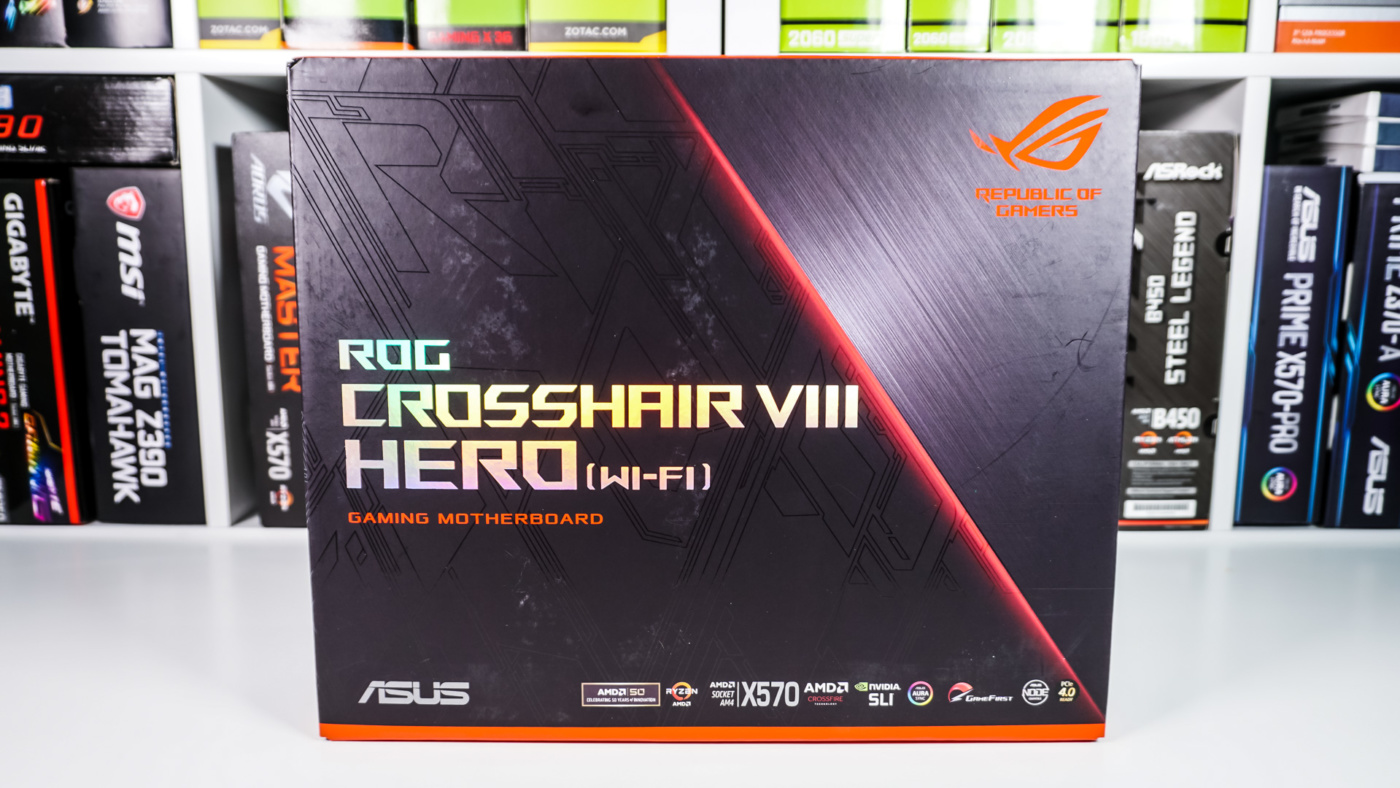
Asus provides a comprehensive selection of accessories with the Crosshair VIII Hero motherboard. This package includes essential items such as a driver disk, manuals, and SATA cables, as well as RGB extensions and a Wi-Fi antenna, ensuring that users have everything necessary to begin their setup. A detailed list of all items included in the box, along with the motherboard itself, is presented below.
- SATA cables
- 1x M.2 screw package
- Support DVD
- ROG big Sticker
- Q-Connector
- Wi-Fi Antenna
- 80cm RGB extension cable
- Addressable LED extension cable
- ROG Coaster
- ROG Thank you card
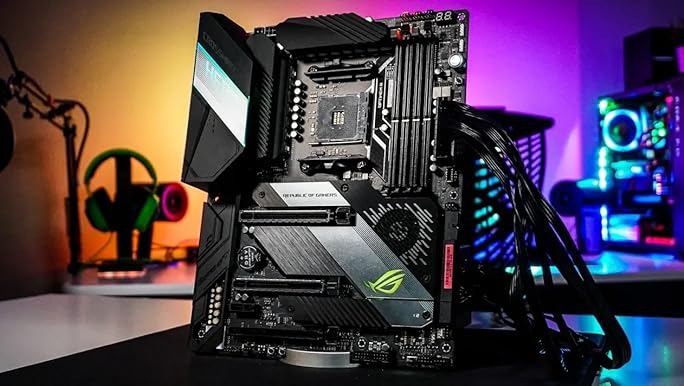
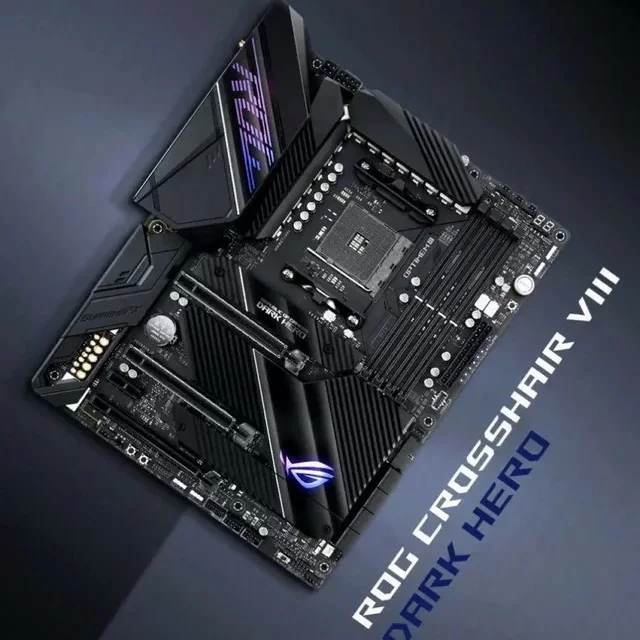
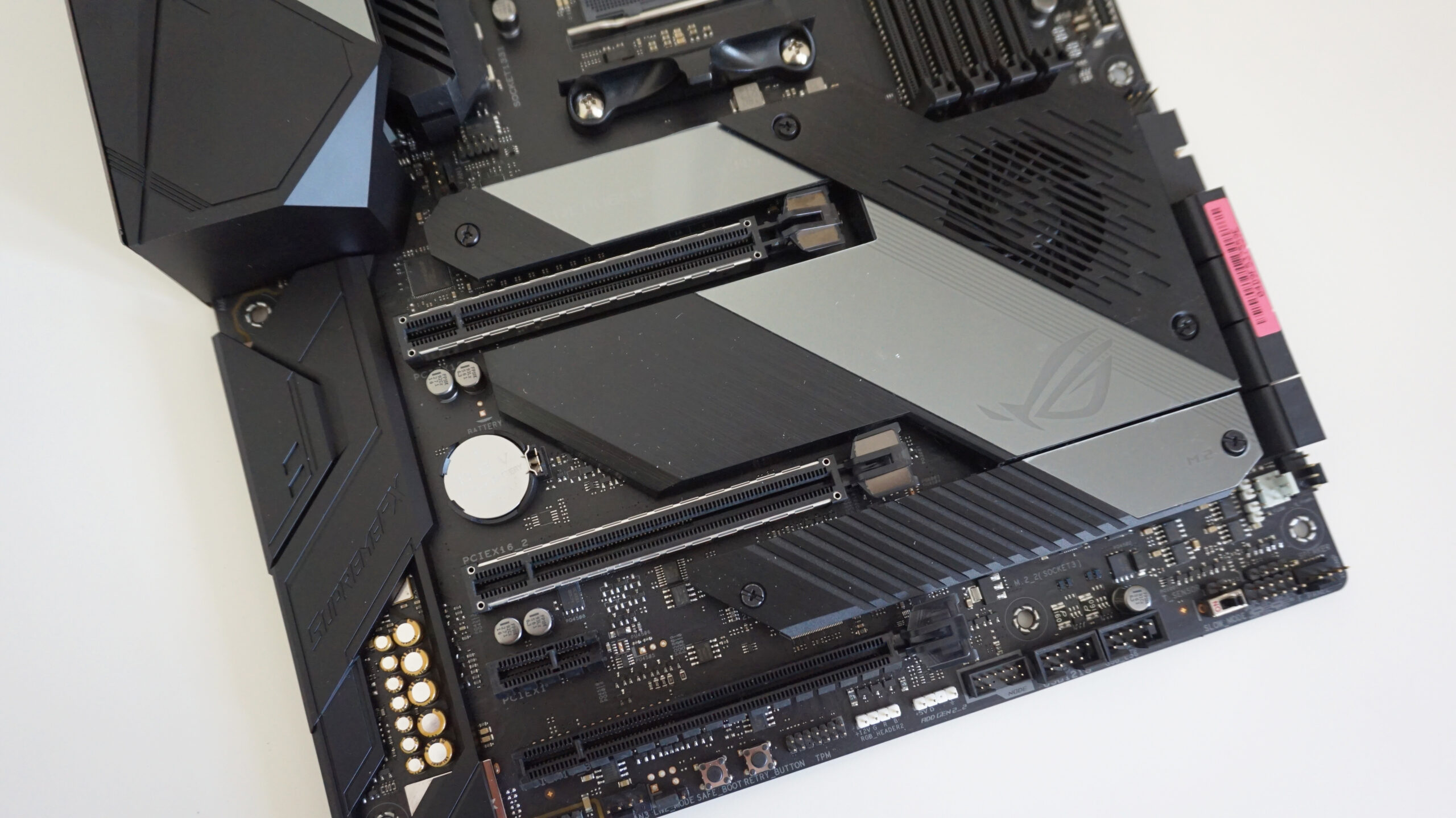
The board itself gives off a premium vibe with a jet black PCB and heatsinks. Accenting the black is a silver swath going through the chipset heatsink and up through the VRM heatsink.
The rear IO heatsink prominently displays the Crosshair VIII name, accompanied by the term "HERO" positioned just beneath it in a silver area, where RGB lighting casts a subtle frosty glow on the text. Additionally, the ROG emblem on the chipset heatsink features RGB illumination, maintaining a similar frosted aesthetic. Control of the RGB lighting is managed through Asus' AURA software.
In addition to the aforementioned features, the VRM heatsinks, audio shroud, and DIMM slots are designed in a black-on-black aesthetic. Two out of the three full-length PCIe slots are equipped with reinforcement to support heavy graphics cards and provide EMI slot protection. The Crosshair VIII Hero Wi-Fi truly embodies the characteristics of a high-end motherboard. Its neutral design elements ensure compatibility with a wide range of build themes.
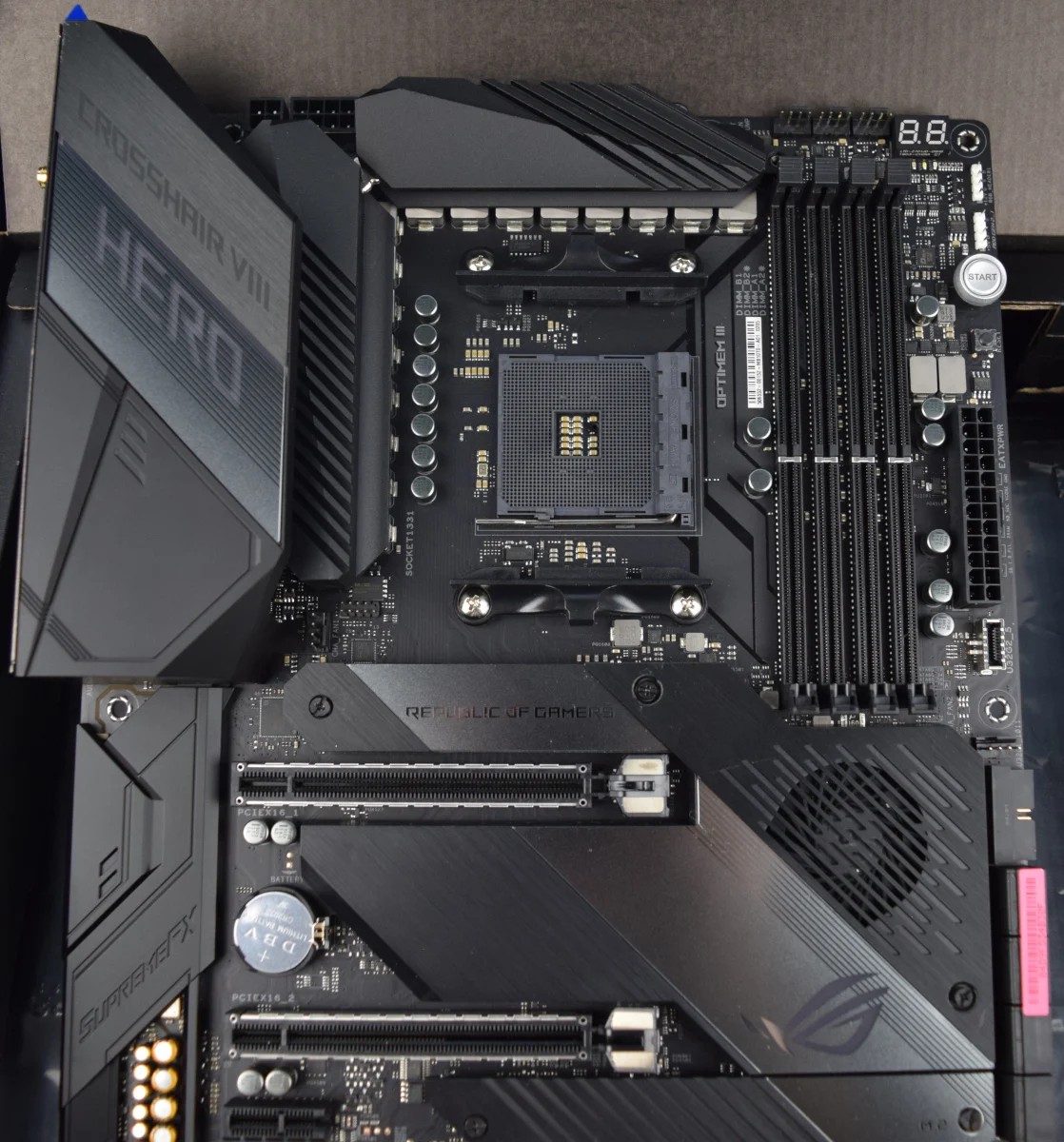
At the uppermost section, positioned on the extreme left, is the rear IO cover that extends over the heatsink. This cover predominantly consists of brushed aluminum, complemented by some plastic elements. The Crosshair VIII designation is displayed at the top, while the term "HERO" is located at the bottom, illuminated by RGB lighting.
The VRMs are supplied with an essential 8-pin connector and an optional 4-pin EPS connector, positioned between the shroud and the VRM heatsinks. This motherboard is equipped with an ASP1405i/Infineon IR35201 8-phase controller operating in a 7+1 configuration. Although the heatsinks are not the largest observed, they are interconnected through a heat pipe, which facilitates the distribution of thermal load. During both standard and overclocked testing, the power components remained well within specified limits.
Asus employs an alternative topology known as teaming, rather than utilizing phase doublers to engage all VRM phases. The company asserts that this approach delivers superior transient response compared to the doubling method. The motherboard features high-quality Infineon PoweRstage IR3555 components, each rated at 60A. Consequently, the VRM possesses ample capacity, ensuring that it can effectively manage the demands of the forthcoming 16-core 3950X processor without difficulty.
To the right of the socket region, one can observe the four DIMM slots, each equipped with a single-sided locking mechanism to facilitate straightforward installation and removal. The motherboard accommodates a maximum of 128GB of DDR4 RAM; however, it is noteworthy that Asus does not specify any memory speeds on the specifications page.
Above the memory slots, there are three out of the eight available 4-pin fan and pump headers. This section specifically includes the CPU_FAN, CPU_OPT, and AIO_PUMP headers. Adjacent to these headers is a convenient two-character Q-Code debug LED display, which is utilized for troubleshooting during the startup process.
On the right side, there is a prominent start/power button accompanied by a smaller, more straightforward reset button. Positioned directly beneath these is the 24-pin ATX power connector, followed by the front panel USB 3.2 Gen 2 header located below it.
A particularly beneficial feature, especially for those engaged in overclocking, is the presence of voltage read points. Given that software can occasionally present inaccurate data, these read points offer the most reliable means of obtaining voltage measurements. The voltage read points encompass ground, Vcore, NB_SOC, DRAM, PLL, and SB.
In the upper right corner, there are two RGB headers out of a total of four. One is a 3-pin ARGB header, while the other is a 4-pin header. The 3-pin header operates at 5V and can accommodate up to 300 individually addressable RGB LEDs, with a maximum power capacity of 3A (5V). The 4-pin connector is designed for 12V LED strips, specifically supporting 5050 RGB LED strips, and also has a power rating of 3A (12V). The control of the connected strips is facilitated through the Asus Aura software.


















































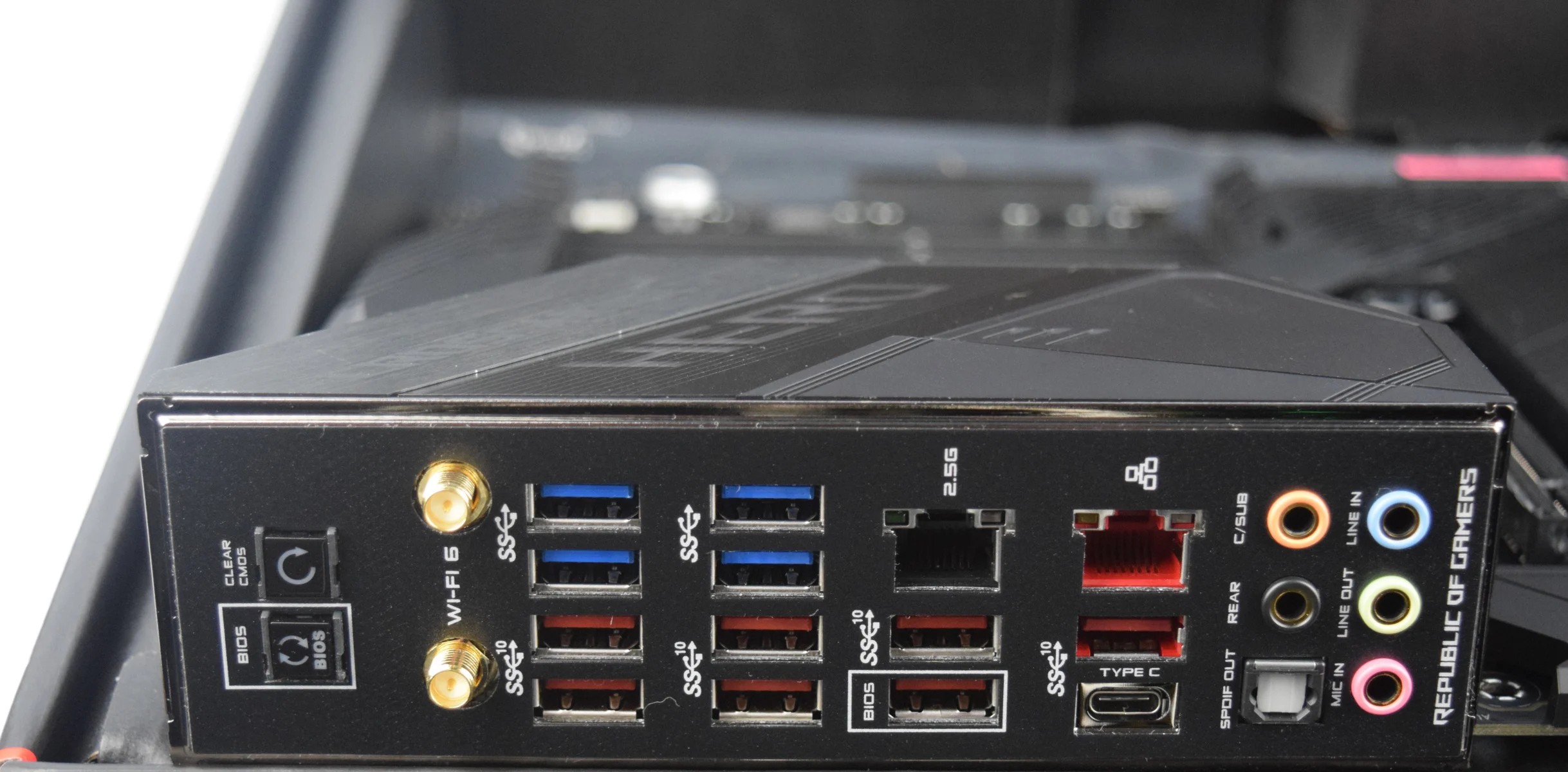
 Returning to the rear I/O section, we encounter a sleek black integrated rear I/O panel that upholds a premium aesthetic. This rear I/O configuration features the highest number of USB ports observed on an X570 motherboard, totaling 12.
This configuration features a total of eight USB 3.2 Gen 2 ports, comprising seven Type-A and one Type-C, in addition to four USB 3.2 Gen 1 ports. Beyond the ample number of USB connections, the setup includes both the Intel I211-AT Gigabit LAN and a Realtek 2.5G LAN port. Additionally, there are Clear CMOS and BIOS Flashback buttons conveniently located for user accessibility. The design also incorporates antenna mounts for the Intel Wi-Fi 6 AX200 (indicated by the gold protrusions) and a gold-plated audio stack, which consists of five 3.5mm audio jacks and an SPDIF output.
The rear I/O of the Crosshair VIII Hero is equipped with a range of features that are standard for motherboards in this category. Its standout attribute is the abundance of USB ports available. However, it is important to note that the motherboard lacks any video outputs. Consequently, individuals intending to utilize integrated graphics on APUs will need to consider alternative options. Nevertheless, it is improbable that users would opt for a budget APU with a motherboard priced significantly higher, alleviating any concerns on this matter.
Returning to the rear I/O section, we encounter a sleek black integrated rear I/O panel that upholds a premium aesthetic. This rear I/O configuration features the highest number of USB ports observed on an X570 motherboard, totaling 12.
This configuration features a total of eight USB 3.2 Gen 2 ports, comprising seven Type-A and one Type-C, in addition to four USB 3.2 Gen 1 ports. Beyond the ample number of USB connections, the setup includes both the Intel I211-AT Gigabit LAN and a Realtek 2.5G LAN port. Additionally, there are Clear CMOS and BIOS Flashback buttons conveniently located for user accessibility. The design also incorporates antenna mounts for the Intel Wi-Fi 6 AX200 (indicated by the gold protrusions) and a gold-plated audio stack, which consists of five 3.5mm audio jacks and an SPDIF output.
The rear I/O of the Crosshair VIII Hero is equipped with a range of features that are standard for motherboards in this category. Its standout attribute is the abundance of USB ports available. However, it is important to note that the motherboard lacks any video outputs. Consequently, individuals intending to utilize integrated graphics on APUs will need to consider alternative options. Nevertheless, it is improbable that users would opt for a budget APU with a motherboard priced significantly higher, alleviating any concerns on this matter.