

















































Pros
- High base clock speed.
- Lowest-cost 6th-generation Core i processor.
- Impressive single-thread performance.
Cons
- Integrated graphics performance lags AMD rivals.
- Locked, preventing overclocking.
Characteristics and Fundamentals of Skylake
In our earlier reviews, we have thoroughly examined the advancements in features associated with Intel's well-known "Skylake" platform, including the LGA 1151 socket of the Core i3-6100 and the different chipsets within the 100-family, particularly the high-end Z170. For those who wish to familiarize themselves with this information or require a brief overview, we highly recommend visiting the second page of our review on the Intel Core i7-6700K. Instead of providing an exhaustive list of the specifications for the Core i3-6100 and its comparison with more advanced Intel Core models, I present a chart directly from Intel that encapsulates the key details of the series.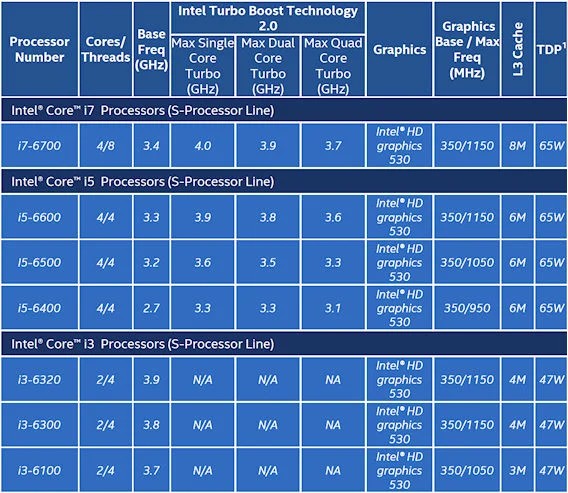 The Core i3-6100 is positioned at the lower end of Intel's 6th-Generation "Core" processor lineup. There are two other Core i3 models with marginally higher clock speeds. However, the Core i3-6100 is often regarded as the most cost-effective option, featuring a clock speed of 3.7GHz and integrated HD 530 graphics that are only slightly underclocked (by 100MHz) compared to its more expensive alternatives.
An additional significant aspect highlighted in the chart above is that Intel's Core i3 processors are rated at 47 watts, in contrast to AMD's premium APUs (including the Athlon X4 880K), which are rated at 95 watts. Although TDP (thermal design power), which measures heat output, does not directly correlate to precise power consumption figures, it is evident that Intel's CPUs maintain a substantial advantage in terms of performance per watt. As will be demonstrated, the Core i3 chip typically surpasses AMD's rival processors in most CPU-centric tasks. If electricity costs are high in your area, this may provide sufficient justification to choose an Intel chip over an AMD alternative; however, it is important to note that incorporating a high-end graphics card into your system will significantly increase power consumption during gaming, exceeding that of any individual processor.
It is important to note that, similar to the Core i7-6700K, this processor necessitates a new motherboard featuring an LGA 1151 socket. It cannot be installed in an existing motherboard that utilizes the Z97 or H97 chipsets. Additionally, it is unlikely that older RAM can be reused, as the majority of new Intel-based motherboards require DDR4 memory. We have been quite impressed with the innovative features introduced in many of the new LGA 1151-compatible Z170 motherboards. These enhancements primarily focus on exceptionally fast storage options through PCI Express x4 M.2 SSD slots and USB 3.1 Gen 2 ports, which effectively double the theoretical bandwidth compared to USB 3.0. For further information regarding these new features and more, we recommend reviewing our analysis of the MSI Z170A Gaming M5, an affordable motherboard priced that showcases some of the finest capabilities of the latest Z170 boards.
However, as highlighted in our analysis of the Athlon X4 880K, several recent AMD Socket FM2+-based motherboards provide numerous features, including USB 3.1 and M.2 storage slots. Additionally, AMD motherboards tend to be more cost-effective compared to their Intel counterparts. This aspect further supports AMD's appeal for those constructing a system from the ground up, particularly when budget considerations are paramount.
In light of this, if you intend to construct a high-performance PC featuring more than two graphics cards and several M.2 drives, the Intel Z170 chipset is undoubtedly superior. It provides greater bandwidth through PCI Express 3.0 lanes compared to the older AMD FM2+ A88X chipset. Therefore, if your upcoming build includes numerous high-end components, we strongly recommend opting for Intel.
The Core i3-6100 is positioned at the lower end of Intel's 6th-Generation "Core" processor lineup. There are two other Core i3 models with marginally higher clock speeds. However, the Core i3-6100 is often regarded as the most cost-effective option, featuring a clock speed of 3.7GHz and integrated HD 530 graphics that are only slightly underclocked (by 100MHz) compared to its more expensive alternatives.
An additional significant aspect highlighted in the chart above is that Intel's Core i3 processors are rated at 47 watts, in contrast to AMD's premium APUs (including the Athlon X4 880K), which are rated at 95 watts. Although TDP (thermal design power), which measures heat output, does not directly correlate to precise power consumption figures, it is evident that Intel's CPUs maintain a substantial advantage in terms of performance per watt. As will be demonstrated, the Core i3 chip typically surpasses AMD's rival processors in most CPU-centric tasks. If electricity costs are high in your area, this may provide sufficient justification to choose an Intel chip over an AMD alternative; however, it is important to note that incorporating a high-end graphics card into your system will significantly increase power consumption during gaming, exceeding that of any individual processor.
It is important to note that, similar to the Core i7-6700K, this processor necessitates a new motherboard featuring an LGA 1151 socket. It cannot be installed in an existing motherboard that utilizes the Z97 or H97 chipsets. Additionally, it is unlikely that older RAM can be reused, as the majority of new Intel-based motherboards require DDR4 memory. We have been quite impressed with the innovative features introduced in many of the new LGA 1151-compatible Z170 motherboards. These enhancements primarily focus on exceptionally fast storage options through PCI Express x4 M.2 SSD slots and USB 3.1 Gen 2 ports, which effectively double the theoretical bandwidth compared to USB 3.0. For further information regarding these new features and more, we recommend reviewing our analysis of the MSI Z170A Gaming M5, an affordable motherboard priced that showcases some of the finest capabilities of the latest Z170 boards.
However, as highlighted in our analysis of the Athlon X4 880K, several recent AMD Socket FM2+-based motherboards provide numerous features, including USB 3.1 and M.2 storage slots. Additionally, AMD motherboards tend to be more cost-effective compared to their Intel counterparts. This aspect further supports AMD's appeal for those constructing a system from the ground up, particularly when budget considerations are paramount.
In light of this, if you intend to construct a high-performance PC featuring more than two graphics cards and several M.2 drives, the Intel Z170 chipset is undoubtedly superior. It provides greater bandwidth through PCI Express 3.0 lanes compared to the older AMD FM2+ A88X chipset. Therefore, if your upcoming build includes numerous high-end components, we strongly recommend opting for Intel.
Evaluation and Summary
Prior to delving into the specifics of the benchmark, it is essential to highlight that, due to the recent introduction of new Intel and AMD processors, we have opted to conduct our CPU testing on Windows 10. The processors evaluated include the Intel Core i3-6100, Athlon X4 880K, AMD A10-7870K, AMD A10-7890K, and AMD A10-7860K, all tested on the Windows 10 platform. In contrast, the older models, namely the AMD FX-8370 and Intel Core i5-6600K, were assessed using Windows 8.1. Consequently, the performance metrics of the Core i5 and AMD FX processors may not be directly comparable to the newer models. However, it is important to note that these older CPUs are significantly more expensive and powerful, and their inclusion serves primarily to offer a comprehensive reference rather than to position them as direct competitors. Although it is not feasible to guarantee that all aspects are directly comparable between Intel and AMD platforms, we conducted tests on all these processors utilizing a SATA-based SSD as the boot drive and 16GB of RAM. To optimize the performance of the integrated graphics in these processors, we evaluated the Core i3 with DDR4 Corsair RAM operating at its maximum rated speed of 2,800MHz, while the AMD systems were assessed with AMD-branded DDR3 RAM functioning at its peak rated speed of 2,100MHz. The speed of the RAM is particularly significant for integrated graphics, as it enhances the chip's ability to process and render pixels effectively.Graphics Tests
In recent times, Intel's integrated graphics have significantly improved, allowing numerous games to be played on desktop CPUs at lower resolutions and settings. However, AMD has typically maintained a competitive advantage in gaming performance with its on-chip graphics when evaluating components within the same price range. With the introduction of a new series of AMD products, we were keen to assess the performance of the Core i3-6100 and its HD 530 graphics, which are slightly downclocked compared to the higher-end Core i5 and i7 models featuring the same integrated graphics processor. It is important to observe that the charts feature a reduced number of comparison chips, as AMD's Athlon X4 880K and FX-8370 do not include integrated graphics. Consequently, a dedicated graphics card is necessary for these processors. In contrast, the Core i3-6100 does not impose this requirement. However, for an optimal gaming experience at resolutions exceeding approximately 1,366x768 and with low-to-medium settings, the use of a dedicated graphics card is advisable.Sleeping Dogs
Subsequently, we tested the open-world action game Sleeping Dogs. Although this title was released in 2012, it remains sufficiently demanding at high settings and resolutions to challenge even mid-range gaming PCs. Therefore, we opted for the Medium detail setting.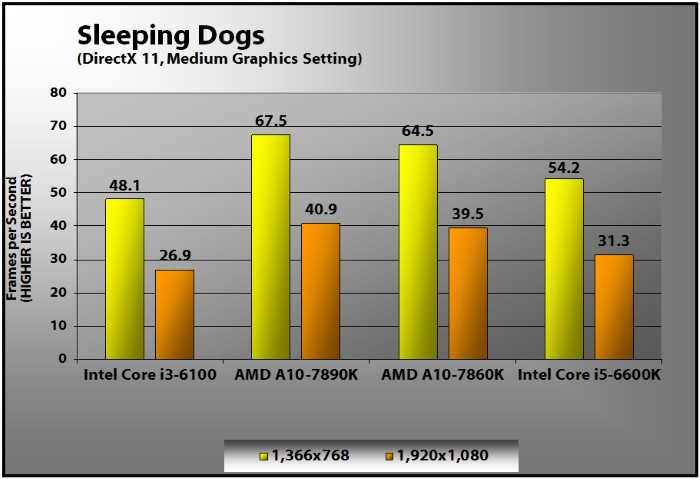 The Core i3-6100 demonstrated consistent performance at a resolution of 1,366x768. However, when the resolution was increased to 1,920x1,080, only the AMD APUs and the Core i5 processor priced above maintained frame rates exceeding 30fps, which is considered the minimum threshold for smooth gameplay. It is important to note that this assessment was conducted using Medium settings. To enhance visual quality further, a dedicated graphics card is essential.





