If you read our review of the Nvidia GeForce RTX 4080 Founders Edition
(opens in new tab), our conclusion was that it's an excellent graphics card marred by an excessive price. The FE's $1,200 / £1,269 / AU$2,219 price is simply beyond the range of mainstream gamers, and that's before considering the premium tier partner cards that cost even more. Consoles look appealing to many.
But now that the Radeon RX 7900 XT
(opens in new tab) and RX 7900 XTX
(opens in new tab) have launched, hopefully those prices are set to trend downwards. Probably not by a lot, but at least they're heading in the right direction. Thank god miners aren't competing this time around.
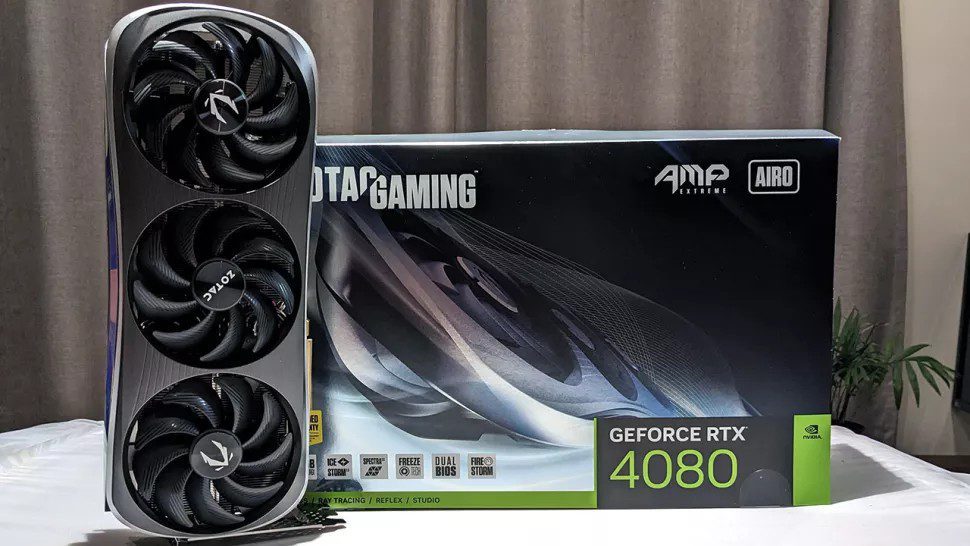
The Zotac GeForce RTX 4080 Amp Extreme Airo is a long name for a big (and curvy!) card. It aims to beat out the Founders Edition in every aspect, purporting to be faster, quieter, cooler, and more feature rich than the FE. At $1,399 / £1,319 / AU$2,349 it's a step up in price—though unusually that's most apparent in the USA—costing $199 more than the launch price of the FE. In the UK and Australia, the pricing of the Zotac is more fair at £50 or AU$130 more than the FE.
The Zotac Airo, like all other RTX 4080s, is built around the 4nm AD103 GPU, which has 9,728 out of a possible 10,240 cores available. That leaves room for Nvidia to release an RTX 4080 Ti in the future. The AD103 gets a huge increase in L2 cache size, at 64MB vs the 5MB of the RTX 3080
(opens in new tab). Add to that much improved ray tracing support, the impressive DLSS 3, and a more than reasonable 320W TDP, and spec wise the RTX 4080 looks very strong.
Other key specs include 16GB of 22.4Gbps GDDR6X memory over a 256-bit bus. That's a step back from the RTX 3080, but then look at the die size of the 4080, at 379 mm² vs the huge 628 mm² of the 3080 and the other GA102 cards. For sure Nvidia is making good money off of the RTX 4080! And when it comes to performance per watt, the RTX 4080 is in a league of its own.
The Zotac Amp Extreme Airo is for now, Zotac's top 4080 card, sitting above the Trinity. It comes with a boost clock of 2,565MHz. Officially, that doesn't seem like much of an overclock over the FE's 2,505MHz. Some top tier cards ship with 2,600MHz+ overclocks, but rated boost clocks mean little and you shouldn't worry about that. In my testing the Zotac was able to reach above 2,800MHz under default operation.
Many manufacturers have repurposed their 450W+ rated RTX 3090 Ti
(opens in new tab) or RTX 4090
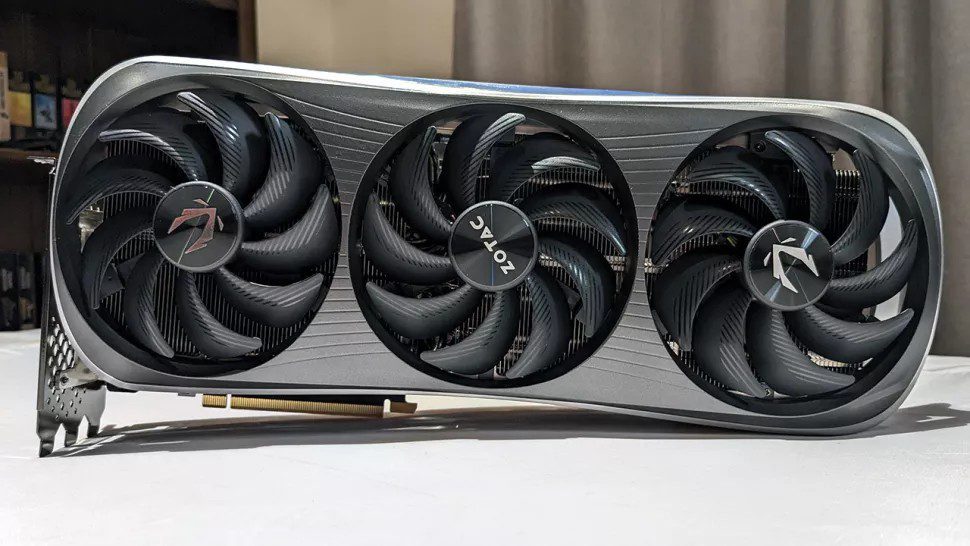
(opens in new tab) coolers for use with the RTX 4080, and it shows after taking one look at it. It's a big 3.5 slot card. The fan shroud features an unusually curved design too. It incorporates attention grabbing RGB lighting along the length of the card, which can be controlled via Zotac's Spectra RGB app.
It's got a full cover metal backplate with another branded RGB element and, personally, I think it's a great looking card.
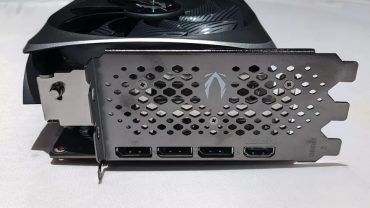
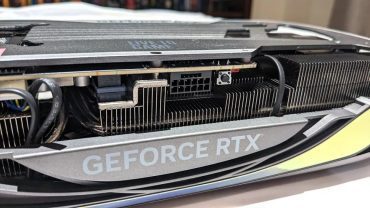
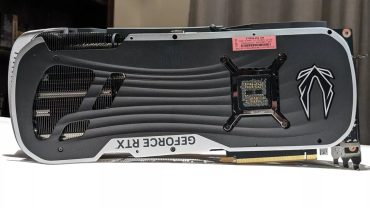
Like all RTX 4080s, the card comes with a 12+4 pin 12VHPWR connector. In this case it has a 3x 8-pin adapter, delivering up to 450W. That's more than enough juice to power the 320W Airo. With 320W, you wouldn't think Zotac needed an extreme PCB, but in a sign that it's built for a higher TDP, the card features a 24-phase VRM with a further three for the memory. Notably, the memory is rated for 24Gbps, more than the card's 22.4Gbps. So you should have some OC headroom on tap.
Other key features include an RGB header for controlling an external strip and dual BIOS with performance and quiet modes. A quick test didn't reveal any difference, and given the overspec cooler, leaving it at the performance setting is recommended. Unusually, it's controlled by a button rather than a switch, with the change applied after a reboot.


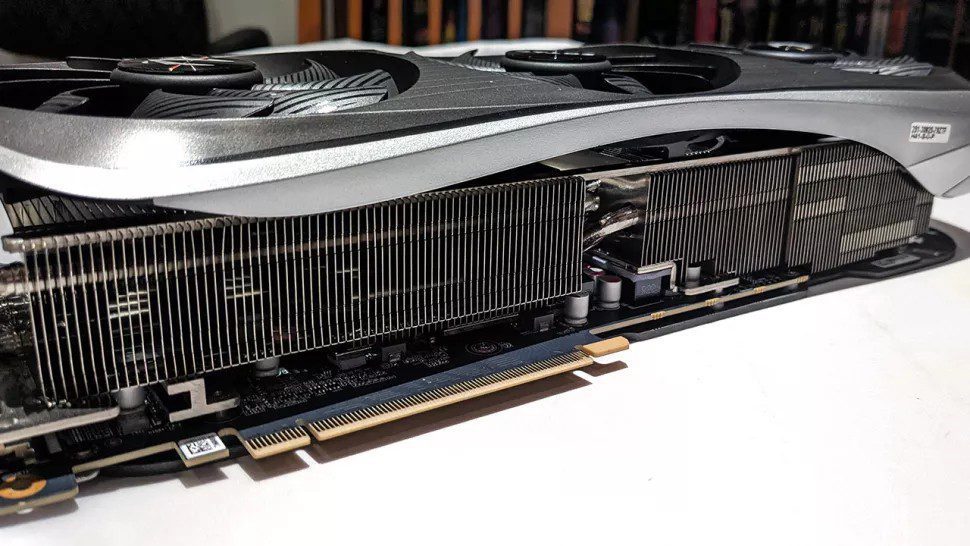
The cooler is more of a traditional design, eschewing the use of a vapor chamber in favor of a traditional nine-heatpipe baseplate. As expected with such a behemoth of a cooler, the heat generated by the AD103 GPU presents absolutely no problem. A peak temperature of just 62°C is excellent, while full system power consumption is also good, coming in below the previous generation high end cards.
The Zotac uses a little under 20W more power than the Founders Edition, but when you factor in all the RGB and an extra fan, that's fine.
But the raw wattage number doesn't tell the true story. As the RTX 4080 dramatically outperforms the likes of the RTX 3080 Ti with less power; it's the performance per watt that really stands out. Well done Nvidia!
Synthetic gaming performance